
The Difference Between Lectio and Other Ed-Tech Chatbots
August 28, 2025
See how Lectio stands out from generic or educational chatbots.
Introduction
The market for AI-powered educational tools is growing rapidly. Students are turning to chatbots for help, and instructors are exploring ways to integrate AI into their courses. But not all chatbots are created equal.
Lectio is not just another AI tutor — it is course-specific, context-aware, pedagogy-aligned, and evidence-based, providing a learning experience that goes far beyond generic chatbots.
Why generic chatbots fall short
Most chatbots rely primarily on their pre-trained knowledge. While this can be impressive, it often leads to answers that are:
- Too general – Not specific to the course or instructor’s materials.
- Misaligned with objectives – May not cover what students are expected to learn.
- Unreliable for assessment prep – Students may get partial or misleading answers.
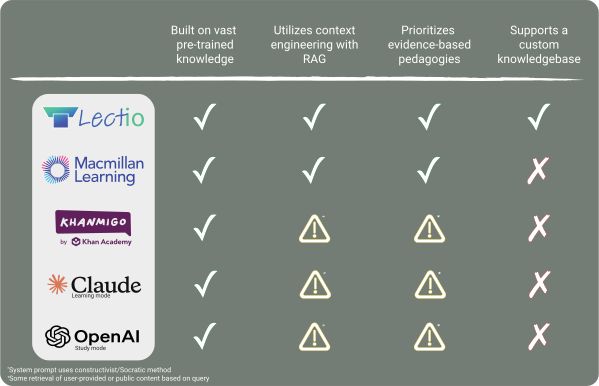
These limitations make it difficult for instructors to trust that students are learning what matters most in the course. Leading AI companies such as OpenAI (ChatGPT) and Anthropic (Claude) market their products towards students and have tools that are geared towards education, such as ChatGPT's study mode or Claude's learning mode. Both of these products seek to "guide" rather than "answer", which indicates that they are likely controlled by an optimized system prompt, an approach that Lectio also incorporates. However, these products do not have the ability to ingest course materials or learning objectives, which are key to Lectio's unique effectivness.
The limitations of ed-tech chatbots
Because AI providers provide access to their models, the last few years have seen a proliferation of ed-tech startups building chatbots for education, all of which are built on the same pre-trained knowledge that ChatGPT study mode and CLaude learning mode rely upon. These chatbots seek to differentiate themselves by adding features useful features based on historical approaches in the ed-tech space.
For example, Khanmigo, an AI tutor built by Khan Academy, integrates with Khan Academy's extensive library of educational content. Similarly, MacMillan's AI tutor, which is integrated with their textbooks, is limited to the content of those textbooks and does not adapt to the specific needs of individual courses or instructors. Other ed-tech chatbots, such as Q-Chat, Quizlet's AI tutor, focus on helping students with specific tasks like creating flashcards or quizzes, but they do not provide comprehensive tutoring that aligns with course objectives. However, all of are limited to the content provided by the company's own knowledge base, whether that be custom educational videos or licensed textbooks, and the do not allow for customization based on specific course materials.
Other companies seek to be an all-in-one solution for educational institutions. Popular learning management systems (LMS) such as Canvas and Blackboard have integrated AI into their platforms in a variety of ways, but not always ways that are useful. Others, such as Kira, include many tools that many instructors will never use. In contrast to these, Lectio offers a focused, effective tool that focuses on tool excellence rather than variety and breadth.
What makes Lectio different
There is a place for generic AI chatbots and chatbots within knowledgbase moats, but they are not sufficient for the needs of higher education, especially for advanced, research based, or highly customized courses. In these cases, students need a tutor that can understand and work with the specific materials and objectives of their course.
Lectio addresses these limitations by combining two overlapping elements:
1. Context engineering
Lectio uses retrieval-augmented generation (RAG), a highly optimized system prompt, and injection of module-specific learning objectives to search your course materials and retrieve the most relevant content, and relate that content to the course objectives. This context engineering ensures that answers are grounded in the actual materials students are expected to learn.
2. Alignment with learning objectives
Because Lectio injects your course and module objectives into every query, students receive answers that are directly tied to the skills and knowledge they are meant to acquire. Students can be confident that their assessments, which align with these objectives, will be well-supported by Lectio’s tutoring. Integrating with evidence- based pedagogies like backward course design is a foundational of Lectio's design, ensuring that all AI interactions reinforce the intended learning goals.
Benefits for instructors and students
For students:
- Tailored, context-aware answers
- Improved preparation for assessments
- Clear alignment with course objectives
For instructors:
- Confidence that AI support reinforces learning objectives
- Reduced need for repetitive clarifications in office hours
- Insight into common student questions and misunderstandings
Conclusion
Lectio is more than a chatbot — it is a course-specific AI tutor that prioritizes your content, aligns with your learning objectives, and integrates evidence-based teaching practices. This makes it a reliable, scalable, and effective learning companion for students in higher education.
In previous posts, we explored context engineering and RAG. Next, we’ll look at how Lectio works hand-in-hand with backward course design to further enhance student learning outcomes.