
Backward Course Design and How Lectio Augments It
August 21, 2025
Explore the principles of backward course design and how Lectio supports evidence-based pedagogy.
Introduction
Effective teaching is more than presenting information — it’s about designing learning experiences that ensure students achieve the intended outcomes. Backward course design is an evidence-based pedagogical framework that helps instructors plan courses by starting with the end in mind (Understanding by Design, Wiggins and McTight 2005).
Lectio is uniquely positioned to augment this approach. By combining context engineering approaches, such as retrieval-augmented generation (RAG), with carefully structured course context, Lectio doesn’t just answer questions—it helps students achieve the outcomes you’ve defined for your course.
What is backward course design?
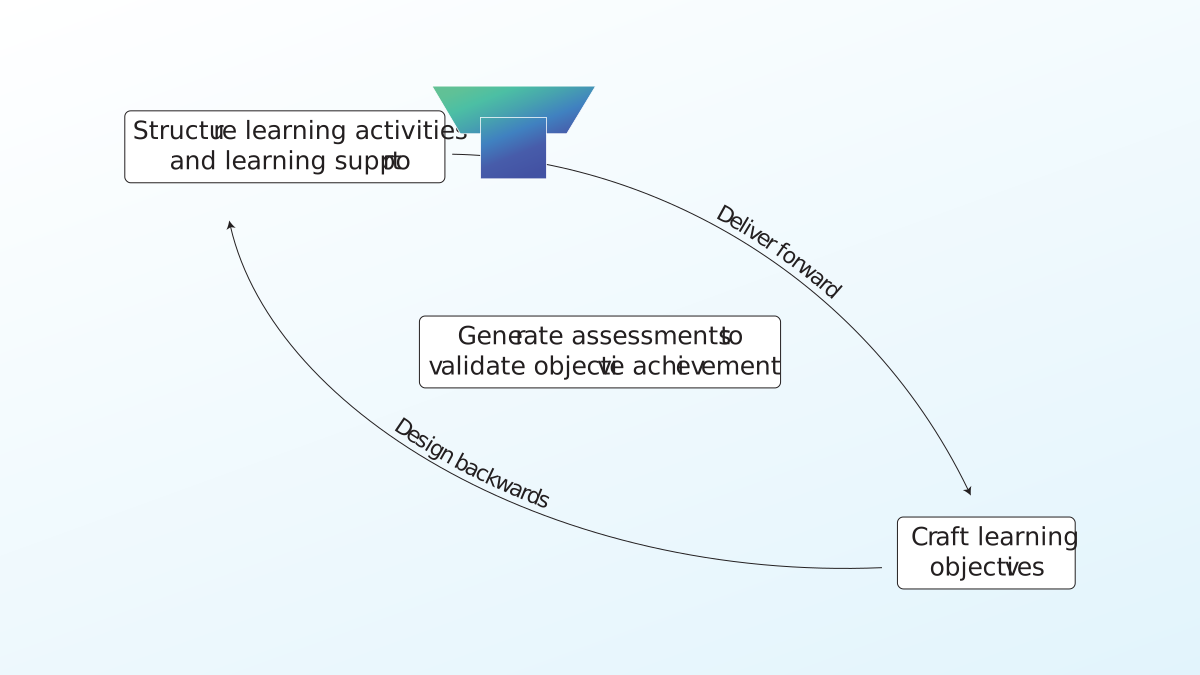
Backward course design involves three key stages:
- Identify desired results – Define what students should know, understand, and be able to do by the end of the course (formally called learning objectives or outcomes).
- Determine acceptable evidence – Decide how you will know that students have achieved those outcomes. This can include exams, projects, performance tasks, or other types of assessments.
- Plan learning experiences and instruction – Design activities, readings, and assignments that lead students to achieve the outcomes.
By planning backward from objectives, instructors create courses that are coherent, aligned, and effective at guiding student learning.
Challenges in course design
Even experienced instructors face challenges with backward design:
- Translating learning objectives into assessment questions that truly measure understanding.
- Ensuring that study materials and guidance align with the desired outcomes.
- Providing personalized support that targets gaps in understanding while also being tailored toward your objectives.
This is where Lectio adds value. It serves as a bridge between your objectives and the student’s learning experience by reinforcing the objectives that you've created. Rather than having to personally provide directed support to each student or training supplemental instructors and tutors, Lectio can provide accurate answers that are aligned with your course goals. You've worked hard on your backward design the course, let Lectio help in forward delivery of the material.
How Lectio augments backward course design
Lectio enhances each stage of backward course design by embedding course context into its AI responses:
1. Alignment with learning objectives
Lectio injects your course’s learning objectives into every student query, ensuring that answers directly support the skills and knowledge you intend students to gain. When you upload your coures content, Lectio automatically extracts learning objectives from your materials, categorizes them into the distinct learning modules you've defined, and then uses student-selected modules to filter the knowledge base and inject the learning objectives into the context behind each query.
2. Context-aware tutoring
Using semantic search, Lectio retrieves relevant course materials to ground its answers. This ensures students receive information aligned with both the objectives and the specific module content, even when the query itself lacks detail.
3. Assessment readiness
Because Lectio’s answers are aligned with your course objectives, students can study with confidence, knowing that their AI-guided learning supports assessment preparation. You'll never hear again the excuse that, "I studied the wrong thing." Lectio's actions can create example questions, practice problems, and study guide templates that are directly tied to your learning objectives.
Benefits for students and instructors
For students:
- Answers tailored to what they need to learn
- Better preparation for assessments
- More efficient and confident study sessions
For instructors:
- Ensures course materials and AI support are aligned - the tutor won't go rogue or hallucinate
- Provides insights into student questions and misconceptions
- Scales support without extra office hours
Looking ahead: comparing Lectio to other ed-tech chatbots
Backward course design and context alignment are what make Lectio more than a generic AI chatbot. In the next post, we’ll compare Lectio to other tools in the ed-tech space and highlight why it stands out as a course-specific tutor.